
THE STATUS OF WOMEN LAND RIGHTS IN PAKISTAN
The status of women in Pakistan varies highly across social, economic, religious and ethnic factors. However, the one thing that remains the same across every divide is the constant fight for reform for the betterment of women in this country. The same patterns can be seen in the concept of women land rights and the extent of their control and ownership over land in Pakistan.
It can be portrayed through an example of a landowner narrating the instance of a local woman from their village who had taken a dowry from her brothers at the time of marriage but then demanded, and thereafter sold, her share of inherited land which in turn led local villagers to sever ties with to such an extent that when she returned after a few years for her younger brother’s wedding, she got a very insipid welcome not only by men but also by the other women of the family. There are several such examples pertaining to the way women are denied their land rights in Pakistan and it stems mainly from the deep rooted patriarchy present in our country.
What do statistics say about women land rights?
A survey, conducted by the United Nations Economic and Social Commission for Asia and the Pacific in rural areas of Punjab in 2014 discovered that merely 36 women out of a thousand surveyed households were entitled to ownership and out of these only 9 had the authority to sell or trade without the consent of their male relatives. The World Bank also analyzed that 4.3% of women own land in Pakistan (World Bank, 2013).
.png)
Women who own land alone (% of women age 15-49): Q5 (highest) is the percentage of women age 15-49 who only solely own a land which is legally registered with their name or cannot be sold without their signature. Each wealth quintile represents one fifth of households with quintile 5 as the richest 20 percent of households while quintile 1 being the poorest 20 percent of households. Furthermore, three percent of women, who own agricultural land, are lacking access to agricultural inputs, irrigation water, and right to sell/purchase land. This makes their farming practices less effective.
The Legal Framework regarding Women Land Rights
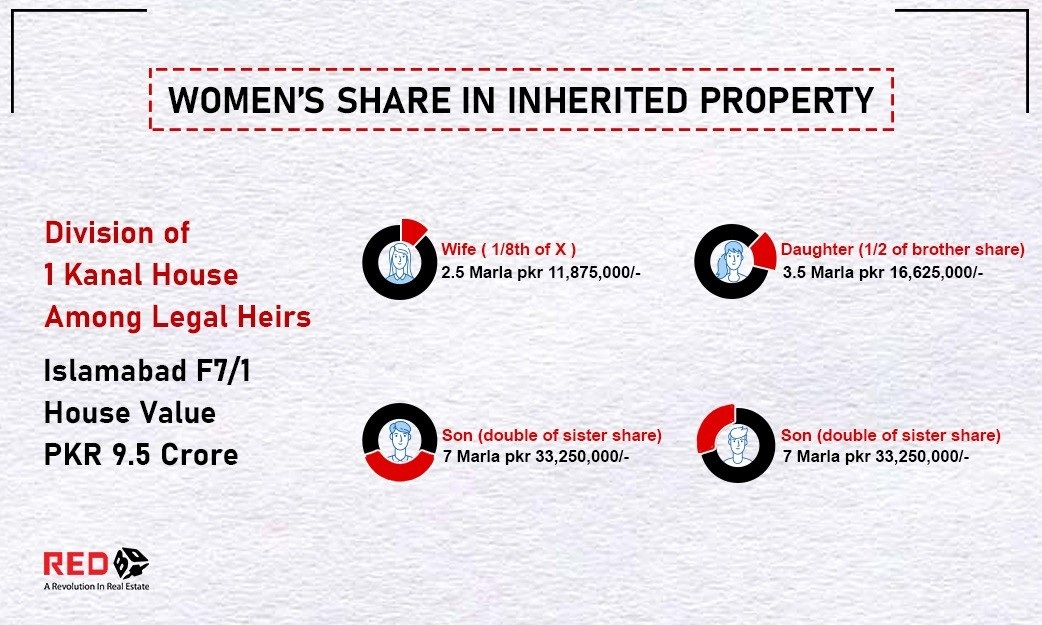
Laws about women’s rights in terms of land and ownership stem from the Sharia law implemented in the Islamic Republic of Pakistan. Article 23 of our constitution says that, ““Every citizen shall have the right to acquire, hold and dispose of property in any part of Pakistan”. And it is then followed by Article 25 that -guarantees equality of rights to all citizens irrespective of sex, race, and class and empowers the Government to take affirmative action to protect and promote women’s rights-. Even though these laws are put in place, the fact that women exercise them is questionable. Socio cultural barriers serve as a hurdle for them to practice their rights and they remain a marginalized group. An example of the division of property can be seen below as well.
Reasons for Women’s Landlessness
The main reasons evolve around misogynistic patterns adapted by most areas of Pakistan, especially rural. Women are denied access because they are not deemed responsible enough and it is considered traditionally unacceptable for a sister to ask for land belonging to the family or any woman to claim her rightful section of land. Secondly, the low literacy rate among women is another reason they are not informed of their respective rights and laws regarding land. They do not know how to go about land registration and transaction procedures, the formal processes of taking up their share of a land. Furthermore, along with being deprived of their rights, women are also subject to unfair cultural practices such as:
- Haq-bakhshwana (where women are either forced or willingly surrender to their right to property),
- Cousin marriages and watta satta (which literally alludes to the concept of give-take, exchange marriage of a pair of male and female with another pair),
- Right of Tanazul (relinquishment)(to reclaim the inherited property that women have a right to)
Reform
As outdated and unfair the system of granting women their rightful share of land is in Pakistan, there have been some positive changes made to try to reform this system. When the PPP government took control in 2008, the Benazir Landless Hari Scheme was implemented to grant over 212,864 acres of government owned land to landless farmers. It gave more priority to women since 70 percent of the intended 5800 beneficiaries of this scheme were meant to be women.
Moreover, the passing of the Prevention of Anti Women Practices Bill 2011 after two failed attempts serves as a positive step towards the empowerment of women in this sector. Under section 498 A, depriving women from inheriting property by deceitful or illegal means shall be punished with imprisonment which may extend to ten years but not be less than five years or with a fine of one million rupees or both. Women have raised their voice against the Bill’s intended purpose but overall, it has reaped a positive impact.
Therefore, outdated policies regarding the control and ownership of land by women need to be replaced, women in rural areas need to be educated in terms of their rights and positive changes and women working in the real estate business today need to be acknowledged.

Leave a comments